Malawi’s trade deficit widened by 8.9 percent in the first eight months of this year as a sharp increase in imports outpaced growth in exports, according to the National Statistical Office (NSO) data.
The trade gap reached $2 billion (about K3.5 trillion) between January and August, up from $1.83 billion (about K3.2 trillion) in the corresponding period last year.
NSO International Merchandise Trade Statistics show that imports increased by 14 percent to $2.7 billion (about K4.7 trillion) during the period from $2.3 billion (about K4 trillion) a year earlier.
Exports, on the other hand, increased to $699.4 million (about K1.2 trillion) from $491.6 million (about K860 billion), reflecting stronger foreign earnings but not enough to offset the rise in import demand.
However, on a monthly basis, Malawi’s trade deficit narrowed in August when the . trade gap fell 8.8 percent to $197.5 million (about K345.8 billion) from $216.6 million (about K379 billion) in August 2025.
The improvement was largely driven by stronger export earnings, with gold exports valued at $53.4 million (about K93.5 billion), helping to boost the country’s overall export receipts for the month.
Reads part of the NSO report in part: “Total exports for August 2026 amounted to $153.2 million [about K268 billion] showing a 38.2 percent increase from $110.8 million (about K194 billion] in August 2025.
“Total imports increased from $327.5 million in August 2025 to $350.7 million in August 2026. This reflected a 7.1 percent increase. The export-to-import ratio was 0.437, indicating that exports were equivalent to 43.7 percent of the import value in August 2026.”
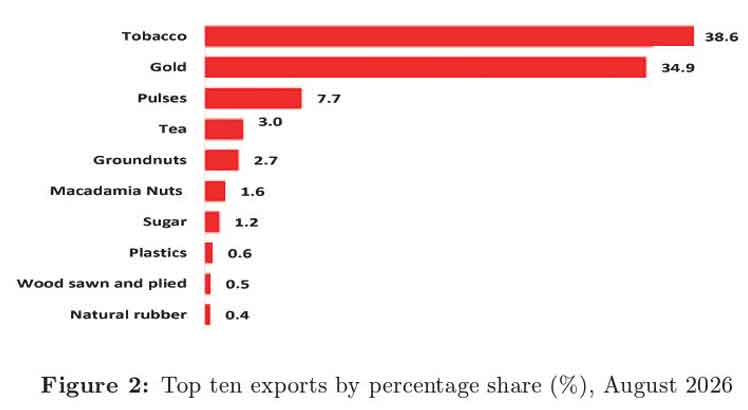
In August, top 10 export commodities accounted for 91.3 percent of total exports led by tobacco at 38.6 percent followed by gold at 34.9 percent, pulses at 7.7 percent and tea at three percent while top 10 imports accounted for 61.6 percent led by fuel at 20 percent plastics at 7.5 percent boiler and machinery seven percent and vehicles 5.7 percent.
In an interview on Monday, University of Malawi economics lecturer Edward Leman said for decades, Malawi has relied heavily on tobacco as its main source of export revenue, with limited and inconsistent efforts towards diversification.
He said: “Value addition has remained largely rhetorical, repeated year after year with little tangible progress.
“As a result, national competitiveness remains fragile and the country is steadily losing comparative advantage in traditional exports such as tea. Compounding this challenge is the fact that domestic production increasingly fails to meet local demand, forcing higher levels of importation.”
Mzuzu University economics lecturer Christopher Mbukwa said in a separate interview that the widening trade deficit is a sign of both structural and transactional weaknesses in the economy.
“The reason for the increased trade deficit is the drop in sales of tobacco, groundnuts and tea,” he said.
Meanwhile, trade expert Paul Kwengwere called for strategic investment in mining, value addition and import substitution, especially on high-value imports such as organic fertiliser plants.
He said: “Accelerate fast yielding mining projects to diversify away from tobacco. Minerals provide a more stable, year-round foreign exchange stream other than seasonal crops.
“Moving from exporting raw products such as soya beans and cotton to exporting refined oil and textiles. This increases the value per kilogramme of exports, effectively multiplying forex earnings without needing more land.”
Ministry of Industrialisation, Business, Trade and Tourism spokesperson Patrick Botha said in an interview that the terms of trade are in line with the ministry’s National Export Strategy (NES II), which targets competitiveness and diversity of export base beyond traditional crops such as tobacco and tea.
Trade deficits continued to pile up despite Malawi implementing the NES II, which sought to diversify exports, move away from reliance on raw tobacco and increase the value of locally manufactured goods.
Imports also continued to surge a year after the Malawi Government imposed an import ban on maize flour, fresh milk, rice and fruits, except those that do not grow in Malawi from April 2025.